Accessorials Explained: Small Differences, Massive Cost Impact
Accessorial charges in LTL shipping can add 15–30% to invoices; accurate data, scheduling, and validation prevent costly surprises.
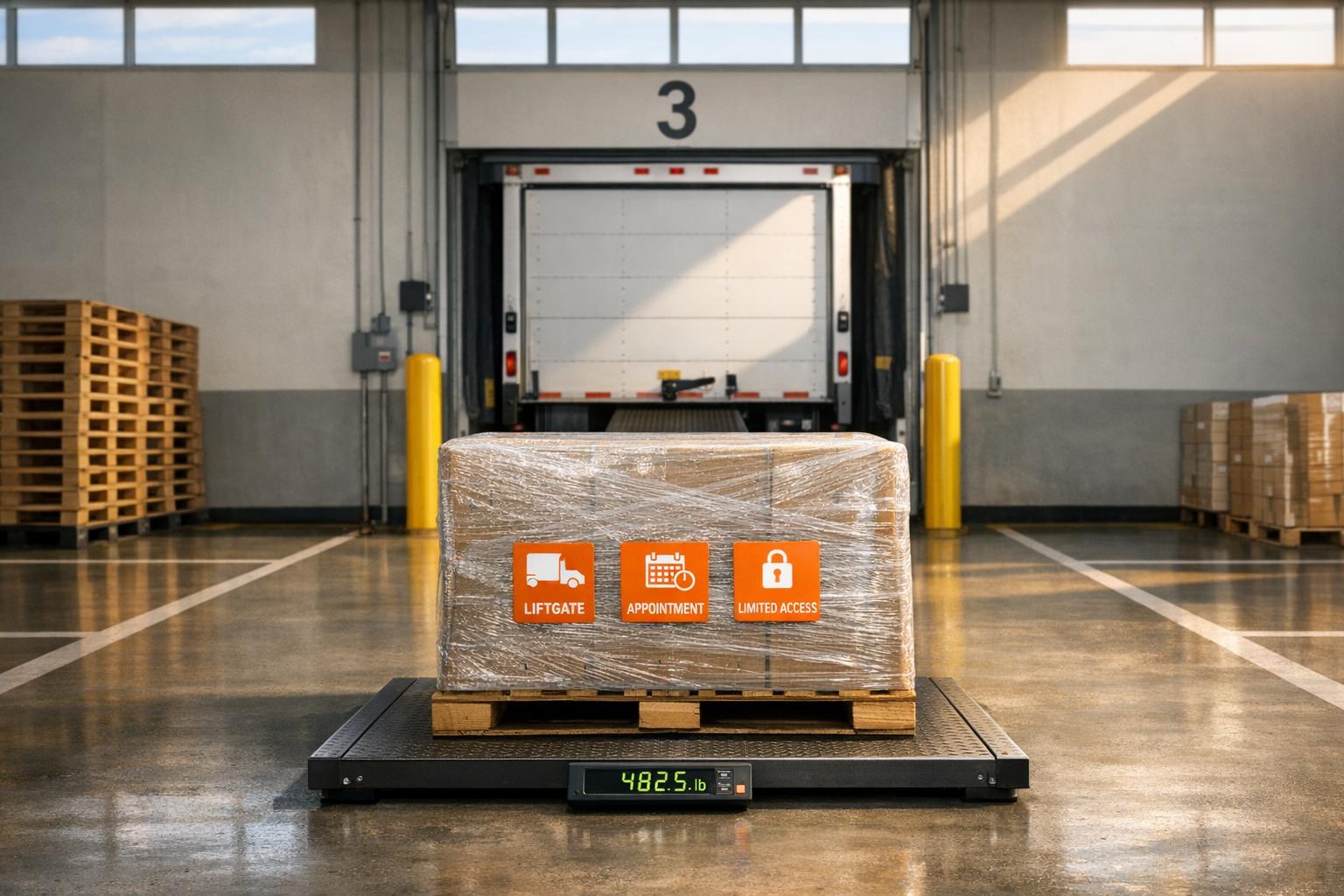
Accessorial charges in less-than-truckload (LTL) shipping are additional fees for services beyond standard dock-to-dock delivery. These costs - like liftgate assistance, residential delivery, or detention fees - can significantly impact your shipping budget if not accounted for upfront. Often overlooked, they contribute to 15–30% of billing discrepancies, making it critical to plan ahead and provide accurate shipment details.
Key Takeaways:
- What triggers accessorials? Non-standard services like limited access delivery, incorrect shipment details, or delays at docks.
- How much do they cost? Fees range from $10 for address corrections to $1,000+ for detention.
- Why do they matter? They can unexpectedly increase costs and distort profitability.
- How to avoid them? Double-check shipment data, verify consignee details, and ensure smooth dock operations.
Tools like ShipPeek LTL TMS can help by automating accessorial management, integrating real-time carrier data, and reducing errors during booking and invoicing. Proactively managing these charges can save both time and money in the long run.
Common LTL Accessorial Charges Explained: Avoid Unexpected Fees
sbb-itb-8138a00
The Hidden Costs: A Breakdown of Common Accessorials
What LTL Shipping Includes by Default - and What It Does Not
LTL (Less Than Truckload) shipping is pretty straightforward at its core: a carrier picks up your freight at one commercial dock and delivers it to another. That’s it. The service is built around this dock-to-dock framework. As Todd Polen, VP of Pricing Services at Old Dominion Freight Line, explains:
“The basic premise was that line haul charges were for a ‘normal’ pickup and delivery. Normal was defined as the carrier showing up, loading freight on the truck, and delivering to a dock somewhere.” [3]
Anything beyond this basic service - whether it’s the pickup location, delivery site, or additional handling - falls under the category of accessorial charges. Each of these extra services comes with its own rules, triggers, and costs.
The Main Categories of Accessorial Charges
To understand these charges, it helps to break them into four broad categories: location-based, equipment-based, time-based, and administrative.
- Location-based charges: These apply when freight is delivered to places outside the standard commercial dock setup. Examples include residences, schools, farms, construction sites, or even prisons.
- Equipment-based fees: These cover tools like liftgates, which are essential when a location doesn’t have a loading dock or forklift.
- Time-based charges: These kick in when delays occur, such as detention fees for a driver waiting on-site for too long - sometimes as little as 15 minutes [1].
- Administrative fees: These include costs like address corrections or reclassification, which happen when the freight’s weight or class on the Bill of Lading (BOL) is incorrect.
The tricky part? Definitions for accessorials can vary by carrier. Each carrier publishes its own “Tariff 100” document, which spells out its specific rules, rates, and terms. For instance, what one carrier defines as “limited access” might differ from another’s interpretation - and sometimes, it’s left to the driver to decide [2] [6].
Patrick Brenda of ShipLDI sums it up well:
“Accessorials are not extra fees. They are a fundamental part of LTL shipping economics. Mislabeling them, misunderstanding them, or ignoring carrier specific tariff differences can quickly turn competitive freight rates into budget overruns.” [2]
What These Charges Actually Cost: Fee Examples in USD
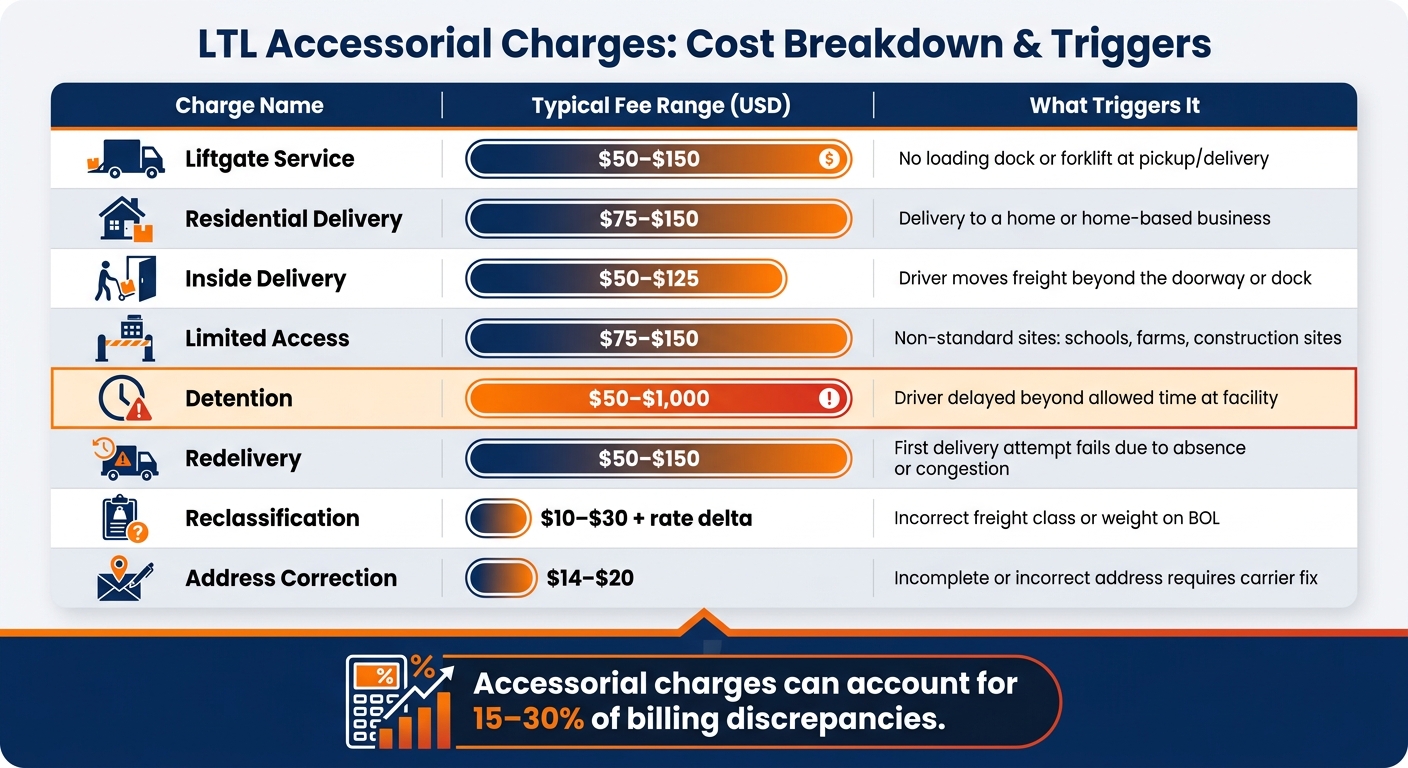
While each accessorial fee might seem small on its own, they can add up fast - especially if you’re managing multiple shipments weekly. Here’s a breakdown of some common charges and what typically triggers them:
| Accessorial Charge | Typical Fee Range (USD) | What Triggers It |
|---|---|---|
| Liftgate Service | $50 – $150 | No loading dock or forklift at pickup/delivery [1] [6] |
| Residential Delivery | $75 – $150 | Delivery to a home or home-based business [1] |
| Inside Delivery | $50 – $125 | Driver moves freight beyond the doorway or dock area [1] |
| Limited Access | $75 – $150 | Delivery to non-standard sites like schools, farms, or construction sites [1] |
| Detention | $50 – $1,000 | Driver delayed at facility beyond the allowed time [1] |
| Redelivery | $50 – $150 | First delivery attempt fails due to absence or congestion [1] |
| Reclassification | $10 – $30 + rate delta | Freight class or weight on BOL is incorrect [1] |
| Address Correction | $14 – $20 | Incomplete or incorrect address requires carrier intervention [6] |
One charge worth highlighting is detention. LTL drivers often handle 15 to 20 stops in a single day [1]. Even a short delay at your location can disrupt their entire schedule. For example, if a driver is stuck for two hours, you could be looking at a detention fee of several hundred dollars for just one shipment. And if accessorial charges aren’t accounted for during booking, carriers often apply them post-delivery at their standard tariff rate [2], which is usually higher than what you’d pay upfront.
How to Cut Down on Accessorial Charges
Get Your Shipment Data Right the First Time
One of the main reasons for accessorial charges is incorrect shipment data. If the weight, dimensions, or freight class listed on your Bill of Lading (BOL) doesn’t align with what the carrier measures, you could face inspection fees (ranging from $10 to $30), reclassification charges, or even a rate adjustment [1]. Modern automated dimensioning technology now catches these inconsistencies, which might have slipped through in the past [2].
To avoid these issues, make sure to double-check your NMFC code before submitting a shipment. Also, ensure your packaging doesn’t exceed 8 feet in any direction to avoid oversize fees [1].
Another important step is verifying that your consignee’s details align with the shipment requirements. This simple check can help prevent unnecessary costs.
Verify Consignee and Delivery Location Details
Providing an incorrect or incomplete delivery address can lead to redelivery fees ($50–$150) or reconsignment charges ($50–$100, plus adjusted freight costs) [1]. If no one is available to receive the shipment, you might also face additional expenses for redelivery.
To sidestep these charges, confirm three essential details with your consignee before booking:
- Exact address: Double-check that the delivery address is accurate.
- Business hours: Ensure the consignee’s operating hours align with the delivery schedule.
- Limited access designation: Determine if the location qualifies as limited access. Places like schools, government buildings, construction sites, and farms often fall into this category.
If the destination lacks a loading dock, it’s better to arrange liftgate services in advance rather than paying for them after delivery [1]. Additionally, make sure your consignee knows that requesting services like inside delivery or liftgate assistance at the last minute can lead to unexpected fees [1].
Prepare Your Dock and Schedule Pickups and Deliveries Carefully
Operational readiness at your facility is just as important as accurate data and verified addresses when it comes to minimizing fees. LTL drivers typically make 15–20 stops per day [1], so delays at your dock can disrupt their entire schedule. Detention fees can start as soon as 15 minutes after a driver’s arrival and may reach as high as $1,000 [1].
To keep things running smoothly:
- Prioritize LTL carriers: Move them to the front of the line when they arrive.
- Be prepared: Ensure your freight is staged and ready before scheduling a pickup. Calling for a pickup when the freight isn’t ready could result in a “Truck Order Not Used” (TONU) fee, which typically ranges from $75 to $150 [1].
- Staff appropriately: Have enough personnel on hand to handle pickups and deliveries efficiently.
Lastly, review your carrier agreements every quarter. Market conditions can affect surcharge formulas and definitions of limited access, so staying informed will help you avoid surprises [8].
How ShipPeek LTL TMS Automates Accessorial Management
Building Accessorial Logic Directly into the Booking Process
Managing hidden shipping costs starts with controlling errors and auditing expenses right at the booking stage. Many unexpected accessorial charges arise because crucial details are overlooked until after the shipment is underway. ShipPeek tackles this issue by ensuring every booking includes a complete data set upfront. This includes precise pickup and delivery addresses, facility receiving hours, and any special handling requirements like dock access or floor load specifications [5].
ShipPeek automatically tags locations based on the originType and destType fields entered for the shipment. This tagging flags stops like residential areas, limited-access locations, or trade shows, applying the correct accessorial charges immediately [7]. For instance, if a shipment is headed to a school, military base, or farm, the system assigns the appropriate fees right away, ensuring the initial quote matches the actual cost. Additionally, ShipPeek integrates carrier-specific tariff data directly into rate calculations. This means charges like liftgate fees - whether flat-rate or weight-based - are calculated accurately for shipments, such as a 2,900 lb load [4] [7].
By automating this process, ShipPeek not only collects essential details upfront but also significantly reduces the likelihood of costly errors later on.
Reducing Errors Before They Become Charges
Once the booking data is captured, ShipPeek validates shipment profiles in real time to catch potential issues. For example, it requires emergency contact details for hazardous materials and blocks bookings with carriers that don’t handle hazmat shipments [7]. The system also prevents conflicting service selections, such as choosing both “arrival notice” and “arrival schedule” for the same shipment, which could lead to billing adjustments [7].
Accessorial verification technology like ShipPeek’s has been shown to reduce billing discrepancies by up to 30%. It also helps speed up invoice processing by as much as 25%, saving both time and money [9].
One Place to Track, Review, and Audit Accessorial Costs
Post-audit rebilling happens when a carrier adds an accessorial charge after delivery at a full, non-discounted rate because it wasn’t accounted for during booking [2]. ShipPeek addresses this by centralizing shipment and invoice data, making it easier to spot and dispute these charges.
Through native API connections with carriers, ShipPeek provides a single platform for managing rating, booking, tracking, and document generation. All shipment details are consolidated in one place, eliminating the need to juggle multiple carrier portals. This unified view makes it simple to identify patterns, such as recurring detention fees at specific locations, and take action to prevent future costs. With accessorial charges sometimes accounting for up to 20% of a total invoice [9], having a clear audit trail is crucial for keeping freight budgets under control while streamlining operations.
Conclusion: Take Control of Hidden Shipping Costs
Managing hidden shipping costs starts with understanding where they come from and taking proactive steps to minimize them. Here’s a quick recap of the most important points to keep in mind.
Key Points to Remember About Accessorial Charges
Accessorial charges exist for a reason - they cover the added costs of non-standard shipping requirements. But the good news? Many of these fees are avoidable with proper planning and attention to detail.
Focus on these three areas to reduce costs:
- Data accuracy: Double-check shipment details to avoid reclassification fees [4].
- Validation of consignee and location details: Prevent unexpected non-discounted fees by ensuring information is correct [2].
- Scheduling discipline: Stick to schedules to avoid detention fees from the start [1].
The bottom line is simple: ignoring accessorial charges doesn’t make them disappear. Instead, it leaves you with no control over them [2]. Keep a close eye on your accessorial charge rate per load to figure out if rising costs are due to internal oversights or carrier policies [5].
These strategies lay the groundwork for automated solutions like ShipPeek to take over.
Using ShipPeek to Keep Accessorial Costs in Check Over Time
As carriers adopt advanced technology to catch errors more quickly [2], manual processes are becoming less effective. That’s where ShipPeek steps in. With its built-in logic, real-time API connections, and centralized audit trail, ShipPeek helps you consistently manage shipping costs. It directly addresses the challenges of data accuracy, validation, and scheduling.
“The most successful LTL shippers treat accessorials with the same level of discipline as base rates: defined, documented, validated, and reviewed regularly.” - Patrick Brenda, ShipLDI [2]
FAQs
Which accessorials apply to my pickup and delivery locations?
Accessorial charges are tied to the specific needs of your shipment and the nature of the pickup or delivery locations. Examples include liftgate services, residential deliveries, limited access locations (like schools or construction sites), and inside pickup or delivery. For instance, if a location lacks a loading dock, a liftgate may be necessary. To avoid surprise fees, evaluate the characteristics of your shipment's locations and communicate these details to your carrier ahead of time.
How can I tell if a stop counts as limited access for my carrier?
When a stop involves special procedures, security checks, appointments, or is in a location that's challenging for trucks to access - like schools, government buildings, construction sites, or remote areas - it may be considered limited access. Always confirm whether trucks can reach the site easily during regular hours without needing extra arrangements. Sharing detailed access information upfront during the quoting process can prevent unexpected fees.
What should I do when a carrier adds accessorial charges after delivery?
If a carrier includes extra accessorial charges after delivery, it's important to act quickly. Start by reviewing the invoice carefully and comparing the charges against your original agreement and shipment details. Look for any inconsistencies or unexpected fees. If something doesn't add up, reach out to the carrier to dispute the charges, and make sure to keep a record of all communications. When needed, negotiate adjustments based on your prior agreement to help reduce costs and ensure the final bill is accurate.