Most Shippers Overpay on Accessorials Without Realizing It
Inaccurate data, manual billing, and weak contracts cause costly LTL accessorial overcharges—fixable with better processes and automation.

Shippers often lose money on hidden fees in LTL shipping, known as accessorial charges. These fees - like detention, liftgate service, or residential delivery - are added for special handling or delays. The problem? Many companies don’t realize they’re being overcharged or billed inconsistently because these fees are buried in dense invoices or applied after delivery.
Here’s the key takeaway:
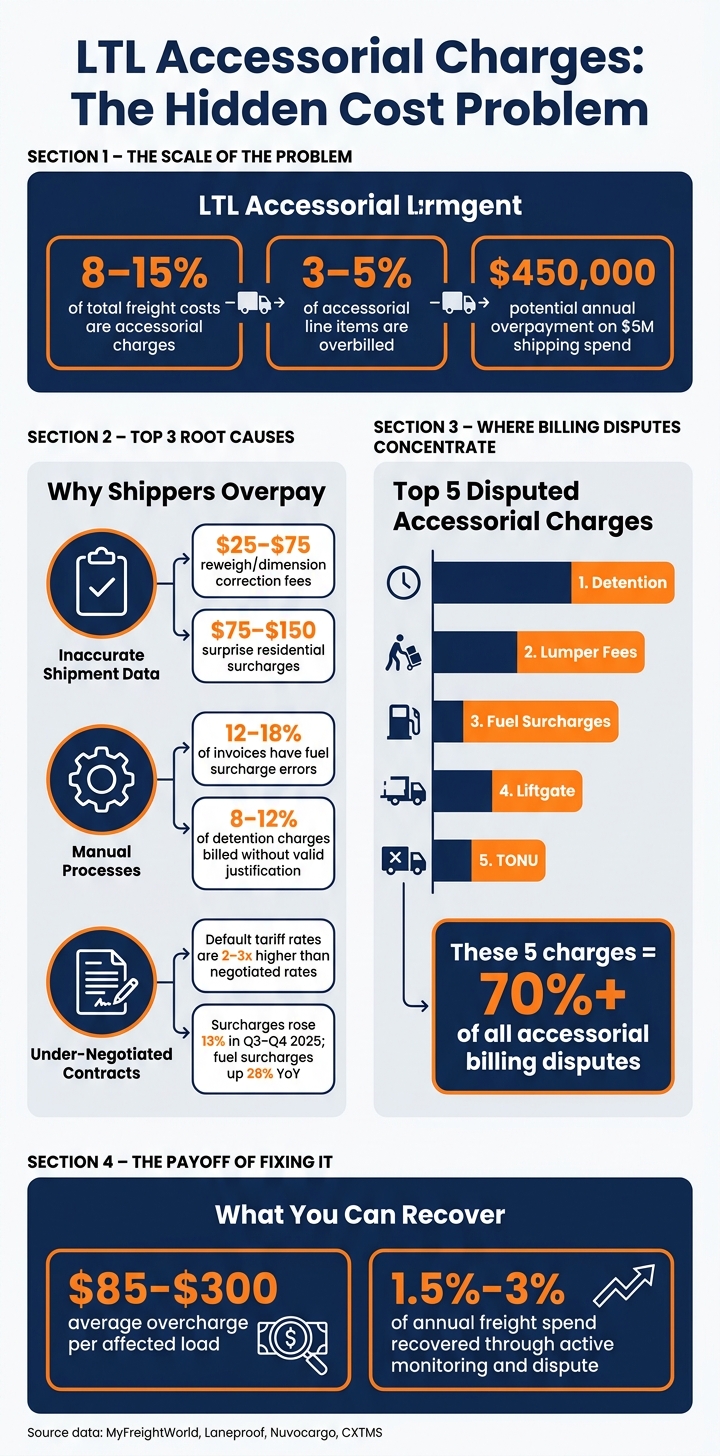
- 8–15% of freight costs come from accessorial charges, and 3–5% of these are overbilled, costing businesses up to $450,000 annually (for $5M in shipping spend).
- Common culprits include incorrect shipment data, manual processes, and poorly negotiated contracts.
- Automation tools like ShipPeek can help identify and prevent these overcharges by providing live rates, flagging errors, and simplifying cost tracking.
Want to stop overpaying? Focus on accurate data, better scheduling, and using tools that catch errors before they hit your bottom line.
What Are Accessorial Charges: Understanding Basic Freight Accessorials Explained
sbb-itb-8138a00
Common Operational Gaps That Lead to Overpayment
To get a handle on overpayments, it’s important to understand what causes them. These charges usually aren’t the result of one-off mistakes. Instead, they stem from repeated process failures that quietly inflate costs over time.
Inaccurate Shipment Data
Errors in shipment data, like incorrect weight, dimensions, or freight class on the Bill of Lading, often lead to accessorial fees. Carriers use reweighing and dimensioning audits to catch these discrepancies, which can result in correction fees ranging from $25 to $75 [5]. And with carriers investing heavily in dimensioning technology by 2026, these charges are only expected to increase [1].
Address classification issues are another common problem. For example, if a shipment goes to a home-based business without being flagged for residential delivery, carriers can tack on a $75–$150 surcharge after the fact. Worse, these charges are often applied at non-discounted rates, far higher than what would have been paid if flagged upfront [5][6].
“A quote that does not include all applicable accessorials is not an accurate quote. It is just the first number you will see before the real bill arrives.” - MyFreightWorld [6]
These data errors often snowball when paired with manual processes.
Manual Processes and Lack of Visibility
Relying on manual entry introduces more room for error - think typos, outdated NMFC codes, or missed details that automated systems can catch. For instance, 12–18% of manually processed invoices contain fuel surcharge errors, and 8–12% of detention charges are billed without valid justification, often because free time isn’t tracked in real time [2].
The lack of visibility compounds the issue. When base rates, fuel adjustments, and accessorial fees arrive on separate invoices - sometimes weeks apart - reconciling the total cost becomes a nightmare without automation. Carriers may even group accessorials under vague labels like “Other Charges” or bury them within the linehaul total. This makes it easy for human auditors to overlook charges on complex invoices [5][4].
“The management challenge is not that accessorials exist - most are legitimate - but that they are applied inconsistently… and almost never systematically reviewed in manual freight programs.” - Nuvocargo [2]
Even with accurate data and better tracking, poorly negotiated contracts can still drive costs through the roof.
Under-Negotiated Carrier Contracts
Shippers often zero in on linehaul discounts during negotiations but leave the details of accessorial fee schedules vague. This oversight defaults to the carrier’s Tariff 100, which lists non-discounted rates that can be 2–3x higher than a negotiated rate [3][1].
Without clear caps or thresholds, charges like detention, residential delivery, and fuel surcharges can spiral out of control - a phenomenon known as “accessorial creep.” Between Q3 and Q4 of 2025, average surcharges rose 13%, while fuel surcharges jumped 26% year-over-year in early 2026, even though diesel prices only increased 4.7% during the same period [3]. Without locked fuel tables or negotiated caps, shippers end up shouldering these additional costs.
“The old habit of chasing the deepest linehaul discount is how companies get ambushed by accessorial creep.” - CXTMS [10]
Tackling these contract-related weaknesses is a crucial step before exploring ways to cut costs effectively.
Practical Steps to Cut Accessorial Overcharges
Identifying where overcharges creep in is just the beginning. The real challenge lies in fixing those gaps before the invoice lands on your desk. By zeroing in on data accuracy, cost tracking, and scheduling, you can tackle hidden accessorial charges head-on.
Improve Data Accuracy and Documentation
A lot of accessorial overcharges stem from inaccurate shipment data. To avoid these costly mistakes, double-check weight, dimensions, and freight class against actual NMFC codes and density measurements before booking. This can help you steer clear of expensive reclassification fees [5]. A pre-booking checklist is also a great tool - use it to confirm dock availability, address classification (residential vs. commercial), and appointment requirements.
“The shippers who consistently pay close to their quoted rate are the ones who identify those circumstances before the shipment moves, not after.” - MyFreightWorld [6]
Keep customer profiles and product dimensions up to date to flag residential or limited-access locations in advance. This proactive step can prevent retroactive surcharges [5].
Once your data is accurate, take the next step by systematically tracking your accessorial costs to catch errors before they pile up.
Track and Analyze Accessorial Spending
Treat accessorial charges as a separate cost layer from base linehaul rates. Between 3% and 5% of accessorial line items are overbilled, with average overcharges running anywhere from $85 to $300 per affected load [5]. Use a three-way match system to compare carrier invoices, rate confirmations, bills of lading, and delivery timestamps [8]. This method can help you spot “ghost charges”, like TONU fees applied to loads that were actually delivered, or duplicate invoices that slip through the cracks.
Five types of charges - detention, lumper fees, fuel surcharges, liftgate, and TONU - make up over 70% of all accessorial billing disputes [5]. Keeping a close eye on these can help you recover 1.5%–3% of your annual freight spending [5].
“Accessorials are where carrier billing errors concentrate. Base rates are negotiated, documented on a rate con, and easy to verify. Accessorials are situational, often lack pre-agreed pricing, and depend on timestamps.” - Laneproof [5]
Once you’ve pinpointed the problem areas, focus on refining your scheduling and dock practices to eliminate unnecessary charges.
Improve Scheduling and Dock Practices
Detention fees are among the easiest charges to avoid. To minimize delays, make sure freight is pre-staged before the carrier arrives, align dock labor schedules with appointment times, and enforce strict cut-off times [10].
Confirm delivery requirements with the consignee before booking to avoid appointment and redelivery fees [6].
“Many shippers assume standard delivery is fine, only to find out the receiving location requires advance scheduling, triggering an appointment fee and a potential redelivery charge if the first attempt fails.” - MyFreightWorld [6]
| Operational Gap | Resulting Charge | Prevention |
|---|---|---|
| Understaffed loading dock | Detention | Align labor shifts with appointment schedules [10] |
| Unconfirmed delivery window | Redelivery/Appointment fees | Verify requirements with consignee before booking [6] |
| Inaccurate site classification | Residential/Limited access fees | Validate address type at order entry [3][7] |
| Freight not pre-staged | Detention | Stage all freight before carrier arrival [10] |
How ShipPeek LTL TMS Reduces Accessorial Overcharges
Operational improvements can only go so far without the right tools to back them up. ShipPeek LTL TMS is specifically designed to catch the accessorial charges that manual processes often overlook.
Live Rates and Automation via APIs
ShipPeek connects directly with carrier APIs, including FedEx Freight, Old Dominion, Saia, Estes Express, and XPO Logistics. This integration ensures live contract rates are pulled in real time, addressing the manual errors and billing inconsistencies that often arise. Each quote provides a detailed breakdown - linehaul, fuel surcharges, discounts, and accessorials - before you book. Research shows that relying on estimated rates (instead of live ones) can lead to billing discrepancies of 15–30% for LTL shipments [9]. ShipPeek’s API delivers multi-carrier quotes in under 2 seconds [9], ensuring you don’t have to choose between speed and accuracy.
By identifying accessorial charges during the quoting process, rather than after delivery, carriers are unable to apply higher, non-discounted post-audit rates later on [1].
Centralized Shipment Data and Unlimited Usage
Accessorial costs often spiral because shippers avoid running detailed rate checks on every load - especially when high per-transaction fees are involved. ShipPeek’s unlimited plan eliminates this issue entirely. With unlimited rate requests, orders, and labels, you can compare rates from over 100 carriers for every shipment without worrying about extra costs [9].
Additionally, your shipment data stays centralized. Every quote, booking, and charge breakdown is stored in one location, making it easy to match invoices against original rate confirmations and catch overcharges before payments are made. This centralized system lays the groundwork for automating accessorial management.
Automated Accessorial Management and Data Validation
ShipPeek simplifies the process of applying accessorial fees. When you request a rate, the system analyzes fields like originType and destType (e.g., “residential” or “limited access”) to ensure the correct fees are applied automatically - no manual input needed [11]. This helps eliminate one of the most common causes of surprise invoices: charges that weren’t accounted for during booking.
The platform also enforces mutual exclusivity rules, flagging conflicting charges automatically. For instance, “arrival notice” and “arrival schedule” cannot be selected together in the same request [11]. When dealing with hazardous materials, ShipPeek filters out carriers that don’t support Hazmat shipments and requires fields like emergencyName and emergencyPhone to be completed before booking. This prevents carrier rejections and penalties after the shipment is underway [11].
| Automation Feature | What It Prevents |
|---|---|
Facility type mapping (originType/destType) | Surprise residential or limited-access fees on delivery [11] |
| Mutual exclusivity validation | Redundant or conflicting accessorial charges [11] |
| Hazmat carrier filtering | Booking with unsupported carriers; missing documentation fees [11] |
| Live tariff rates via API | 15–30% billing discrepancies from outdated rate estimates [9] |
With these automated features, ShipPeek catches common accessorial errors - like incorrect location types, missing documentation, or conflicting services - before the shipment even moves, not after the invoice lands on your desk.
Conclusion: Spend Less on Accessorials with Better Processes and the Right Tools
Overcharges on accessorial fees often result from process gaps and data mistakes, not because carriers are always at fault. These errors happen when shippers leave room for billing inaccuracies. Issues like incorrect shipment data, missing location details, and reliance on manual processes create opportunities for mistakes. As Patrick Brenda, an LTL expert, explains:
“The most successful LTL shippers treat accessorials with the same level of discipline as base rates: defined, documented, validated, and reviewed regularly.” [1]
Preventing these overcharges starts before the shipment even leaves. Ensuring accurate weights, specifying facility types, and completing Bills of Lading (BOLs) during order entry removes much of the guesswork. Shippers who actively monitor and dispute accessorial discrepancies can recover between 1.5% and 3% of their total annual freight spend [5] - all without changing carriers or renegotiating contracts.
While operational improvements are critical, they’re most effective when paired with the right tools. ShipPeek LTL TMS simplifies the process by providing live rates, automatically applying location-based fees, and centralizing quotes and bookings in one platform. This system complements the operational changes discussed earlier. With a free 7-day trial and pricing starting at $999 per month (introductory rate of $749 for the first three months), the investment in better visibility often costs less than a single overlooked fee, like a residential delivery charge or detention cost.
FAQs
Which accessorial charges are easiest to audit first?
When auditing freight charges, some fees are more prone to errors than others. Here’s a quick breakdown of the key ones to double-check: - Liftgate Fees: These charges can easily be added incorrectly, so verify their necessity and accuracy. - Residential Delivery Surcharges: These often slip through unnoticed or are misapplied. Confirm whether the delivery location truly qualifies as residential. - Address Classification Corrections: Mistakes in classifying delivery addresses can result in unnecessary fees. Double-check the classification to avoid paying more than needed. For other charges, a bit of detective work is essential: - Detention Fees: Compare driver check-in and check-out times against facility logs to ensure the charges align with the actual waiting time. - Lumper Fees: If your carrier uses flat-rate programs, make sure lumper fees match those pre-negotiated rates. - Fuel Surcharges: These should be calculated based on the contracted reference index. Confirm that the correct index is being applied. By regularly auditing these specific line items, you can catch discrepancies early and avoid paying more than necessary. It’s all about staying proactive and detail-oriented.
What shipment details most often trigger surprise fees?
Surprise fees can sneak up when shipment details are incomplete or incorrect during booking. For instance, if you don't specify whether a delivery location is residential or lacks a loading dock, you might face residential or liftgate fees. Similarly, providing inaccurate freight dimensions, weight, or class can result in unexpected charges. Failing to mention inside delivery or special handling requirements is another common culprit. Also, overlooking whether the consignee needs an appointment or has restricted access can lead to additional costs.
How can I catch accessorial overcharges before paying invoices?
To keep extra charges at bay, accuracy during the booking process is key - don’t wait to address issues through invoice disputes later. A simple pre-booking checklist can help you confirm essential shipment details, such as dock availability, freight dimensions, and whether the destination is residential. By declaring all required services upfront, you can ensure that the quotes you receive match the final invoices. With ShipPeek, you can access live contract rates directly through carrier APIs. This feature minimizes unexpected costs and keeps your invoices consistent with carrier bills.