How APIs Improve Supply Chain Compliance
APIs automate validation, documentation, and security to reduce errors and billing discrepancies in supply-chain compliance.
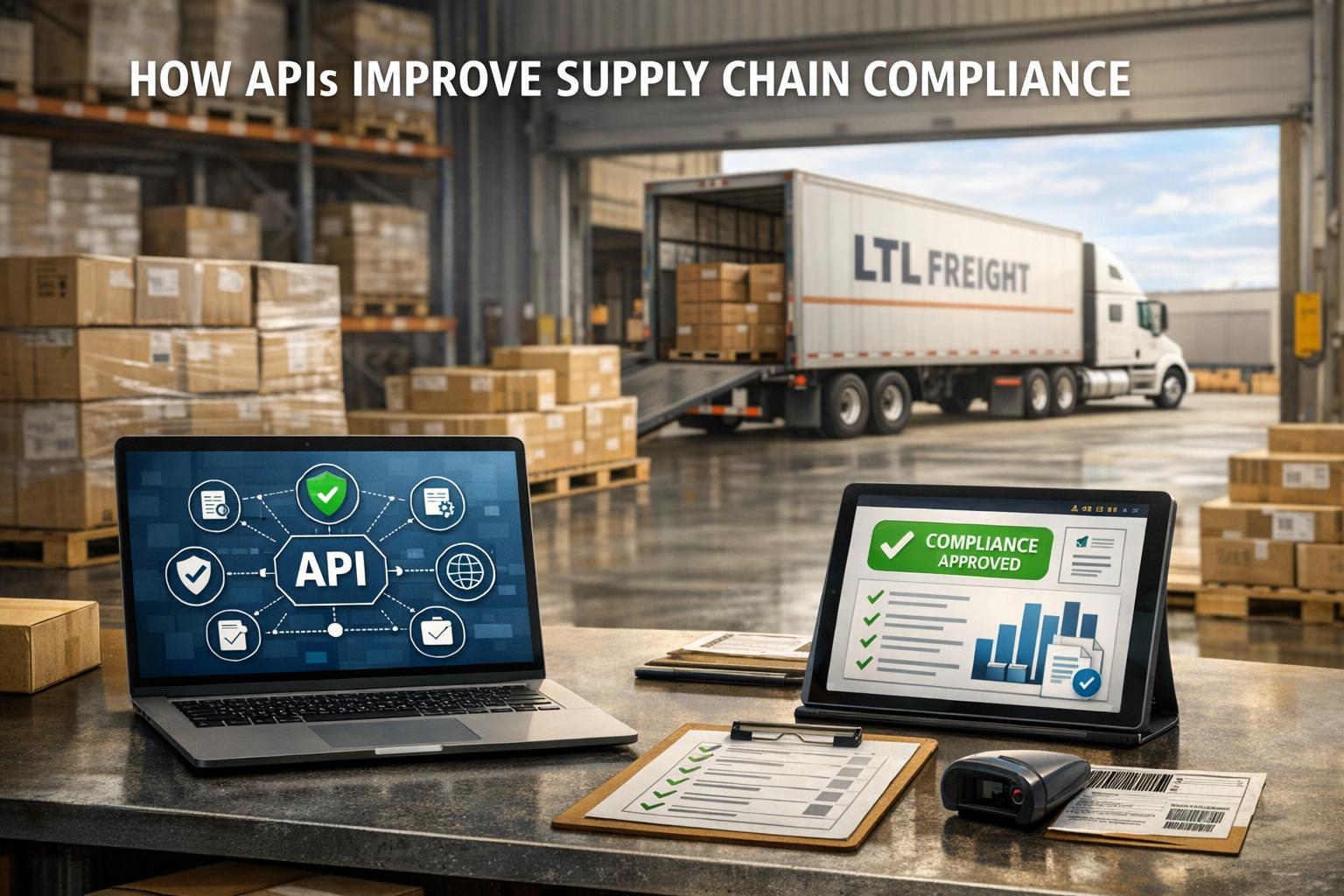
APIs are changing how companies manage supply chain compliance by automating tasks, ensuring accurate data, and connecting systems in real time. They help logistics teams avoid errors like billing discrepancies, missed paperwork, or outdated regulations. Here’s what you need to know:
- What APIs Do: APIs link systems like ERP, TMS, and WMS with carriers and compliance tools for instant data exchange. Unlike older methods like EDI, APIs work in real time, reducing delays.
- Compliance Challenges: Companies face issues with regulatory requirements (e.g., customs, hazmat handling), carrier agreements, and operational accuracy. APIs address these by automating processes like address validation, rate pulls, and document generation.
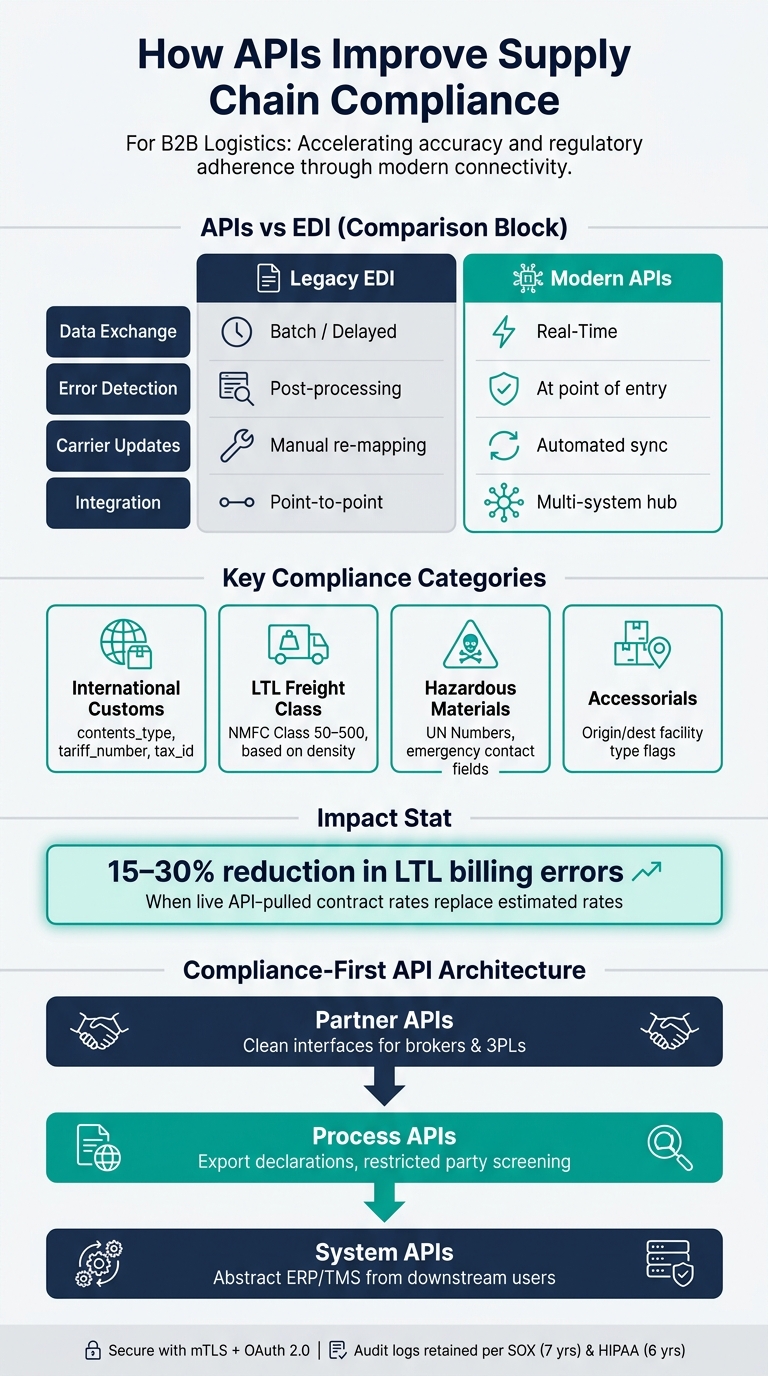
- Key Benefits: Businesses using APIs see fewer manual errors, quicker adjustments to carrier updates, and better alignment with compliance needs. They also reduce billing errors by 15–30% on LTL shipments.
- Implementation Tips: Align compliance needs with API capabilities, test configurations in sandbox environments, and secure data with tools like mTLS and OAuth 2.0.
APIs streamline compliance workflows, making supply chains more efficient and error-free.
Webinar: Revolutionizing Supply Chains with APIs
sbb-itb-8138a00
Matching Compliance Requirements to API Capabilities
Once you’ve identified compliance challenges, the next step is to align these requirements with your API’s capabilities.
Identifying Regulatory and Contractual Needs
Compliance starts with understanding regulatory mandates, contractual obligations, and operational standards. Here’s how these factors come into play:
- Regulatory Mandates: These include customs declarations, such as specifying tariff numbers, Incoterms, and declared values, as well as protocols for handling hazardous materials. For example, businesses shipping to Switzerland with annual sales exceeding CHF 100,000 must register for Swiss VAT and include their tax ID in all customs declarations [8].
- Contractual Obligations: These involve carrier-specific service terms, rate agreements, and documentation standards. For domestic less-than-truckload (LTL) freight, the National Motor Freight Classification (NMFC) system assigns a freight class (ranging from 50 to 500) based on density. Class 50 is for dense goods (over 50 lbs/ft³), while Class 500 applies to very light items (under 1 lb/ft³) [10].
Translating Compliance Rules into API Specifications
To meet compliance requirements, translate them into API configurations by defining fields, validation rules, and endpoint behaviors. Here’s an example:
- A hazardous materials rule might require API fields like
hazardous: true,emergencyName,emergencyPhone, andunNumber[4][12]. - Customs requirements could translate into fields such as
tariff_number,contents_type, andtax_id[8].
The table below outlines how common compliance categories align with API specifications:
| Compliance Category | Required API Fields | Validation Standard |
|---|---|---|
| International Customs | contents_type, tariff_number, value_amount, tax_id | HS Codes, EORI Numbers [8][13] |
| LTL Freight Class | freightClass, weight, length, width, height | NMFC (Class 50–500) [10][11] |
| Hazardous Materials | hazardous, emergencyName, emergencyPhone, unNumber | UN Numbers, Hazchem Codes [4][12] |
| Accessorials | originType, destType, charges[] | Carrier-specific facility types [4] |
Testing these mappings in a sandbox environment ensures that required fields and validation rules are correctly implemented without impacting live shipments [9][11]. This process lays the groundwork for integrating LTL-specific features.
Adding LTL-Specific Compliance Features
LTL shipping introduces additional compliance complexities. Carrier billing rules, for instance, require accurate accessorial charges - fees tied to specific pickup or delivery conditions. These charges are applied automatically when API fields like originType and destType correctly reflect the facility type, whether it’s a residential address, construction site, military base, or trade show venue [4][14].
Platforms like ShipPeek LTL TMS (https://shippeek.com) simplify this process by offering real-time carrier rate access, automated bill of lading (BOL) generation, and normalized PRO numbers. This provides logistics teams with consistent, auditable records across all carriers [9][11].
However, some accessorial fields are mutually exclusive. For instance, arrival notice and arrival schedule cannot both be included in a single API call. Selecting both - or the wrong one - will trigger an error [4]. Addressing these constraints during integration can save significant troubleshooting time.
Building a Compliance-First API Strategy
A compliance-first API strategy goes beyond simply linking systems. It focuses on designing connections that inherently enforce regulatory requirements at every step, rather than treating compliance as an afterthought.
Connecting APIs with Legacy Systems
Many supply chains still depend on EDI (Electronic Data Interchange) for critical transactions. Common ANSI X12 formats like 204 (motor carrier load tender), 210 (freight invoice), and 214 (shipment status) remain staples in transportation networks [1]. To modernize these systems, you can wrap legacy EDI processes with managed APIs and orchestration middleware. This approach bridges batch-oriented EDI with real-time compliance checks.
A layered architecture is particularly effective for this integration. Here’s how it works:
- System APIs: These abstract your ERP or TMS systems from downstream users.
- Process APIs: These handle specific business functions, such as export declarations or restricted party screenings.
- Partner APIs: These provide clean, governed interfaces for brokers and 3PLs, hiding the complexity of internal systems [5].
By maintaining this separation, you can preserve the constraints of legacy systems while introducing the flexibility needed to enforce compliance rules at each layer. This structure also lays a solid foundation for implementing strong security measures.
Securing API Access and Protecting Data
For secure machine-to-machine communication, mutual TLS (mTLS) is a strong choice. It authenticates both the client and server, removing the need for shared secrets [15]. For partner or user-facing access, OAuth 2.0 with short-lived, narrow-scoped tokens helps prevent privilege creep over time [15].
Centralizing security at the API gateway ensures consistent enforcement across your ecosystem. Sensitive information, such as shipper PII or trade terms, should be isolated in dedicated endpoints. Apply data masking before sharing any payloads with external partners [16][6]. Additionally, API keys and certificates should always be stored in managed vaults, not in code or configuration files [16].
“Trust must be engineered, not assumed.” - Defensive Cloud [15]
Once endpoints are secured and data integrity is maintained, the next step is to standardize compliance data.
Standardizing and Validating Compliance Data
One of the most common issues in logistics is inconsistent data formats across carriers, which leads to billing errors. For instance, estimated shipping rates can result in 15–30% billing discrepancies on LTL shipments compared to live, API-pulled contract rates [3]. A canonical data model - a unified internal standard for shipment, carrier, charge, and location data - can eliminate these inconsistencies across your ERP, TMS, and WMS systems [7][5].
Every API call should be validated against a versioned contract. Assign a correlation ID to each transaction to link order release, booking, tracking, and invoicing into a single, auditable chain. This is especially important when regulators or auditors need to reconstruct a shipment’s history [7][5]. By combining legacy system integration, robust security, and data standardization, you create a compliance framework that reduces errors and ensures regulatory adherence.
“Logistics integration fails operationally long before it fails technically. APIs may be available, but if shipment events are delayed, duplicate, or semantically inconsistent, planners and customer service teams lose trust in the data.” - SysGenPro ERP [7]
Automating Compliance Workflows with APIs
APIs are revolutionizing compliance workflows by automating complex tasks like customs procedures, safety enforcement, and data validation. This shift eliminates manual processes, making operations more efficient and accurate.
Automating Customs and Documentation Processes
When shipments are prepared for transit, customs filings require detailed information such as EORI codes, HS classifications, and declared customs values. APIs simplify this process by accepting data in JSON format and submitting it directly to customs authorities. They also generate essential documents like the Single Administrative Document (SAD), Export Accompanying Document (EAD), and Bills of Lading (BOL), complete with downloadable links once processed [13][11].
To keep things running smoothly, webhook notifications provide instant updates on declaration status changes. Plus, asynchronous orchestration ensures that delays caused by government agencies or retries don’t disrupt workflows, unlike synchronous API calls [13][5]. This level of automation ensures compliance with carrier standards without added hassle.
Enforcing Carrier and Safety Standards
APIs are instrumental in enforcing carrier and safety protocols during shipment bookings. For hazardous shipments (hazardous: true), the API requires fields like emergencyName and emergencyPhone to be completed. If these fields are missing or the shipment is unsupported, the API rejects the request immediately [4]. Similarly, location-specific rules are managed by identifying facility types - such as military, construction, or limited access - using fields like originType and destType. This ensures carriers are fully informed of any site-specific restrictions [14][4].
By handling these requirements upfront, APIs not only meet safety standards but also reduce the likelihood of errors further down the line.
Cutting Manual Errors with Real-Time Validation
APIs bring real-time synchronization between ERP order data and logistics events, eliminating the need to manually duplicate or re-enter shipment details across systems [5]. This synchronization also allows for real-time rate pulls, preventing billing discrepancies before they become larger issues.
Additionally, API schema validation catches errors early. It flags missing contact details, invalid postal codes, or conflicting selections - like choosing both arrival notice and arrival schedule - before the booking is finalized. By identifying these issues at the source, APIs ensure smoother operations and greater data accuracy.
Monitoring and Governing API-Based Compliance
Once automation is in place, maintaining continuous oversight of API performance is essential for ensuring compliance over time. Effective monitoring builds on the gains of automation by safeguarding long-term adherence to regulations and operational standards.
Tracking API Performance and Error Rates
Keeping a close watch on API responses is a cornerstone of compliance management. Each API response typically includes a status field, and anything other than "ok" signals the need for immediate investigation. Monitoring error rates helps catch issues like validation failures, carrier rejections, or missing documentation before they escalate.
Response time is another critical factor. Slow API responses can clog workflows, delaying essential filings and creating inefficiencies. By comparing response times to predefined thresholds, you can ensure smoother operations. Testing updates in a dedicated sandbox environment further minimizes risks by allowing workflow changes to be evaluated without impacting live shipment data.
Armed with these performance metrics, the next step is to establish strong governance practices to protect your API ecosystem.
Managing Governance and Vulnerabilities
Monitoring alone isn’t enough - governance plays a crucial role in sustaining API integrity and ensuring regulatory compliance.
Start by thoroughly documenting all API endpoints and implementing strict access controls. Use individual audit logs to track activity, and conduct regular reviews to maintain accountability. Retaining logs in compliance with SOX (minimum of 7 years) and HIPAA (6 years) is non-negotiable. As APIScout emphasizes:
“Individual attribution is the single most common HIPAA audit failure. Service accounts shared across team members prevent individual accountability.” [17]
Conduct quarterly access reviews and promptly revoke credentials when team roles change. This proactive approach reduces vulnerabilities and strengthens your security posture.
Additionally, automate updates to accessorial triggers and service rules to stay aligned with carrier-side API changes. As Evan Knauss, Strategic Marketing Specialist at ProShip, Inc., points out:
“In 2026, carriers are introducing new APIs, adjusting label requirements, refining rules, and tightening documentation specifications at a rapid pace with little notice.” [2]
Being prepared for these shifts ensures your operations remain compliant and adaptable.
Centralizing Compliance with ShipPeek LTL TMS
Centralizing compliance efforts simplifies API management and ensures consistency across operations. ShipPeek LTL TMS serves as a single integration hub, consolidating data from over 100 LTL carriers into one streamlined system. Instead of juggling separate connections with varying formats, error handling, and documentation requirements, this unified platform standardizes processes through a single API layer. This approach significantly reduces billing errors - 15–30% of inaccuracies in LTL shipments can be avoided by pulling live contract rates directly from the API [3].
The platform also automates the creation of Bills of Lading, shipping labels, and pickup confirmations, eliminating manual steps and ensuring compliance documentation is always accurate. For teams focused on auditing freight spending or carrier performance, freight analytics and lane trend data can be easily exported from the dashboard. This creates a clear, auditable record of how carriers adhere to service-level agreements, making compliance tracking more efficient and transparent.
Conclusion: Using APIs to Strengthen Supply Chain Compliance
APIs have reshaped supply chain compliance by turning manual, reactive tasks into proactive, automated systems. By seamlessly linking ERPs, TMS platforms, and carrier systems in real time, APIs eliminate the need for repetitive manual processes and reduce the risk of costly errors or audit issues.
This automation leads to clear operational improvements. Features like real-time validation, automated documentation, and standardized data models ensure data accuracy and compliance across all systems. This keeps critical elements - such as commodity codes, Incoterms, and partner identities - consistent throughout your entire network.
As SysGenPro aptly explains:
“When ERP order data, logistics execution events, and compliance decisions are not synchronized through a governed enterprise connectivity architecture, organizations absorb avoidable cost through shipment holds, manual rework, and audit exposure.” [5]
To fully leverage these benefits, secure and well-governed API interactions are critical. Strong access controls, schema validation, and audit logging are necessary to protect sensitive trade data and provide the visibility compliance teams need to act swiftly. Without these safeguards, even the most advanced automation can fall short.
A practical example of this integration approach is ShipPeek LTL TMS. It simplifies compliance by normalizing carrier data, automating documentation, and enforcing field-level validations for all connected carriers. [18] This reduces billing errors, eases audits, and adapts to frequent updates in carrier APIs - a hallmark of the shipping landscape in 2026. [2]
FAQs
What data should our API validate to prevent compliance errors?
To steer clear of compliance issues, the API must verify critical data points such as tracking numbers, weights, addresses, shipment IDs, declared values, and hazardous material details (including emergency contact information). It should also validate service types and compliance-related documentation, like customs declarations. Properly validating this information not only simplifies regulatory processes but also minimizes the chances of costly errors.
How do we connect APIs to EDI-based legacy systems safely?
To securely link APIs with EDI-based legacy systems, start by using secure authentication methods such as OAuth 2.0. Protect data during transmission by encrypting it with TLS 1.3. Adding an API gateway is crucial for monitoring and safeguarding traffic. Regular security audits should also be part of your routine to identify and address vulnerabilities. Additionally, always verify the identity and permissions of API requests to prevent unauthorized access. Strengthen security further by enforcing multi-factor authentication (MFA). By following these practices, you can create a secure bridge between modern APIs and older legacy systems.
What API security controls matter most for compliance data?
Protecting compliance data requires a robust approach to API security. Here are some essential measures to consider: - Strong encryption: Use protocols like TLS 1.3 to secure data in transit and prevent unauthorized interception. - Multi-factor authentication (MFA): Add an extra layer of security by requiring multiple forms of verification before granting access. - Access controls: Implement strict authentication and authorization mechanisms to ensure only the right users can access specific data. In addition to these, conducting regular security audits helps identify vulnerabilities and maintain compliance. Using API keys to authenticate users and limit access further strengthens data protection efforts. These practices are vital for safeguarding sensitive information while meeting regulatory standards.