The Hidden Cost of Wrong Accessorials - And How to Avoid Them
Accessorial mistakes in LTL can eat 3–7% of freight spend—prevent them with accurate data, process controls, and automation.
In LTL shipping, accessorial charges cover extra services like liftgate use or residential deliveries. These fees, ranging from $50 to $200, can quickly escalate if not managed properly. Errors - such as missing service requests or incorrect data - lead to billing disputes, delivery delays, and financial losses. For businesses, these mistakes can cost up to 7% of annual freight spend, with reclassification charges, detention fees, and redelivery costs adding up fast.
Here’s what you need to know to avoid these errors:
- Common Mistakes: Manual data entry, outdated records, and disconnected systems often trigger billing issues.
- Financial Impact: Errors can result in overbilling, operational disruptions, and strained carrier relationships.
- Prevention Strategies: Use accurate data, verify service needs during booking, and adopt automated tools like ShipPeek LTL TMS for real-time error detection.
Why Accessorial Errors Happen
Manual Entry Mistakes and Bad Data
Accessorial errors often start with manual entry slip-ups. Simple mistakes like using the wrong location type, leaving out required services, or relying on outdated dimensions can snowball into unexpected charges.
For instance, misclassifying limited-access locations - like schools or military bases - can result in fees of about $75 per shipment [2]. Another common example is failing to request a liftgate service during booking, which leads to higher, non-discounted fees later on.
Outdated master data only makes things worse. When incorrect data - such as outdated records or missing service details - gets entered, it often leads to surprise costs down the line.
“Missing accessorials does not eliminate the cost. It only removes your ability to control it.” - Patrick Brenda, LTL Writer, ShipLDI [1]
These problems are further compounded when systems don’t communicate effectively.
Disconnected Systems and Fragmented Workflows
When systems like your ecommerce platform, order management system (OMS), and carrier portals don’t share information seamlessly, errors are almost inevitable. Key details - such as whether a delivery is residential, requires a liftgate, or involves limited-access - can get lost during handoffs.
This lack of integration often causes shippers to rely on estimated rates instead of live contract data, which contributes to 15–30% of billing discrepancies on LTL shipments [5]. Without proper system alignment, the same location might be coded differently across platforms, leading to recurring fees that only get caught during month-end invoice reviews - when it’s often too late to dispute them.
“Companies that manage freight by headline rate alone are bleeding money in the fine print.” - CXTMS [3]
These data gaps can escalate as errors resurface at later shipment stages, disrupting workflows and driving up costs.
Where in the Process Errors Are Most Likely to Occur
Accessorial errors tend to crop up at specific stages in the shipping process. Here’s a breakdown of common trouble spots:
| Stage | Common Error | Resulting Charge |
|---|---|---|
| Checkout / Rating | Missing location type or service flag | Residential or limited-access fee added post-delivery |
| BOL Creation | Incorrect weight, class, or NMFC code | Inspection fee plus reclassification charge |
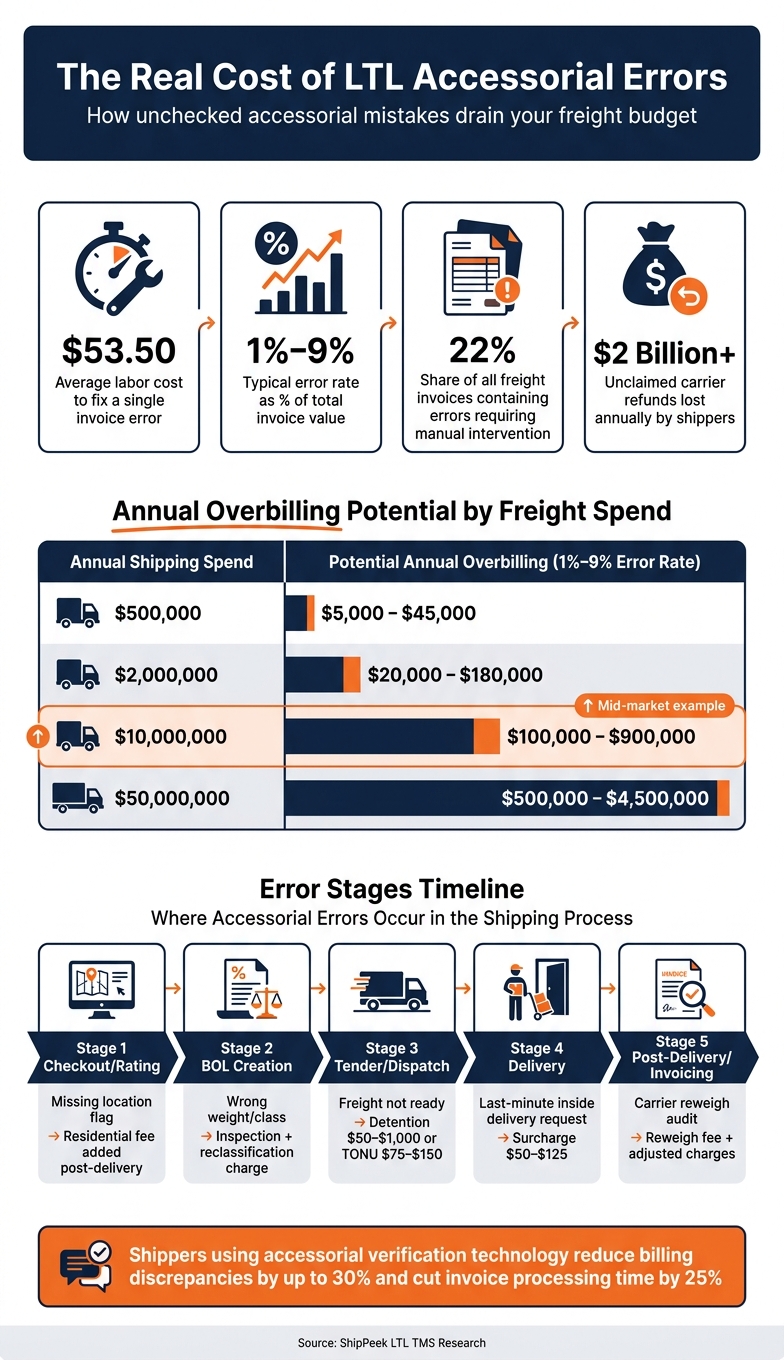
| Tender / Dispatch | Freight not ready when driver arrives | Detention ($50–$1,000) or Truck Order Not Used fee ($75–$150) [4] |
| Delivery | Consignee requests inside delivery on the spot | Inside delivery surcharge ($50–$125) added after the fact [4] |
| Post-Delivery / Invoicing | Carrier reweigh or dimensioning audit catches discrepancy | Reweigh fee plus adjusted freight charges |
The delivery stage is particularly problematic. Consignees often request last-minute services like inside delivery or sort-and-segregate without realizing these come with additional costs. By the time these charges show up on the invoice, shippers have limited options to contest them.
Adding to the challenge, carriers are increasingly using advanced dimensioning technology and post-delivery audits to catch errors that previously went unnoticed. These audits often result in rebilled charges at higher rates. Pinpointing error-prone stages is crucial to avoiding unnecessary accessorial fees.
sbb-itb-8138a00
Handle LTL Shipping Disputes Like a Pro: An Expert’s Strategy Guide
The Real Cost of Getting Accessorials Wrong
Direct Financial Losses
Getting accessorial charges wrong can be a costly mistake. When these charges aren’t accounted for correctly, shipments are billed at standard tariff rates instead of the rates you’ve negotiated. That difference alone can add up quickly. On top of that, fixing a single invoice error costs an average of $53.50 in labor, and such errors typically make up 1%–9% of total invoice value. For mid-market shippers, this translates to 3%–7% of annual freight spend [6][7].
“A shipment that appeared competitive at booking can quickly become one of the most expensive loads once accessorials are added back in.” - Patrick Brenda, LTL Expert [1]
Another hidden cost comes from unclaimed service failure refunds. Carriers often require claims to be filed within 15 days, but most shippers lack the systems to catch these opportunities. As a result, over $2 billion in refunds go unclaimed every year [6].
These financial losses often set the stage for even bigger operational headaches.
Operational Problems
When accessorial details are overlooked, it doesn’t just hurt your bottom line - it disrupts your operations. Missing critical requirements like a liftgate or a limited-access flag can cause delivery failures. This leads to redelivery attempts, missed appointment windows, and unhappy consignees.
“When these fees are not identified upfront, they lead to unexpected charges, strained Carrier relationships and costly billing disputes that can delay invoicing, disrupt customer expectations and damage trust.” - Banyan Technology [2]
Frequent disputes and rebills can also harm your reputation with carriers. Over time, this friction may reduce your pricing leverage and limit access to capacity, particularly during tight freight markets. Additionally, inaccurate accessorial data skews your cost-to-serve metrics and lane profitability analyses, increasing the risk of underpricing future shipments [1].
Even small accessorial errors can snowball into much larger issues, making it clear why accuracy is so critical.
How Small Errors Add Up Over Time
The financial and operational challenges caused by accessorial errors often compound over time. For instance, a single mistake - like a $75 or $95 charge - might seem minor. But when that same error is repeated across multiple shipments, the costs grow fast. These errors are rarely isolated; they’re often systemic, such as a miscoded location type or incorrect dimensions, which can affect every similar shipment until someone catches the problem [7].
The table below shows how these errors scale based on annual shipping budgets:
| Annual Shipping Spend | Potential Annual Overbilling (1%–9% Error Rate) |
|---|---|
| $500,000 | $5,000 – $45,000 |
| $2,000,000 | $20,000 – $180,000 |
| $10,000,000 | $100,000 – $900,000 |
| $50,000,000 | $500,000 – $4,500,000 |
Source: [6]
On average, 22% of all freight invoices contain errors or exceptions that require manual intervention [7]. For businesses handling high volumes of shipments, this means spending significant time and money fixing preventable problems. These inefficiencies highlight the importance of addressing accessorial issues at the source.
How to Prevent Accessorial Errors
Process Changes That Reduce Errors
One of the best ways to prevent errors is to verify location types during the booking process. Maintaining a database that flags specific delivery types - like residential, limited access, or dock-equipped locations - can help you avoid unexpected fees. But this only works if your shipping data is clean and reliable.
“The most successful LTL shippers treat accessorials with the same level of discipline as base rates: defined, documented, validated, and reviewed regularly.” - Patrick Brenda, LTL Expert [1]
Two simple adjustments can also make a big difference. First, only schedule pickups when freight is 100% ready. This avoids “Truck Order Not Used” fees, which typically range from $75 to $150. Second, align your staffing with delivery windows to avoid detention charges. These small process changes can save time and money.
Keeping Your Shipping Data Clean and Accurate
Accurate shipping data is essential for avoiding costly accessorial errors. Since the NMFTA’s July 2025 changes (Docket 2025-1), 70%–80% of LTL freight is now classified based on density alone [8]. That means weight and dimensions are the most critical factors affecting costs. Shippers who use outdated measurement methods may face re-rates on as many as 1 in 4 shipments [8].
Take Douglas Dynamics, for example. In fall 2024, the company - known for its work truck attachments - discovered that 25% of their shipments had incorrect weight, length, or classification data. After testing a dimensioner at one facility, their re-rate percentage dropped to just 1%, and the system paid for itself within months [8]. To ensure data accuracy, calibrate scales weekly, maintain a centralized SKU database with precise weight and dimension details, and photograph shipments to support any disputes.
Keeping data clean doesn’t only reduce errors - it can also improve carrier relationships. For instance, ULINE maintained accurate shipment data long enough to negotiate an annualized flat rate with its carrier. This eliminated individual accessorial charges and allowed ULINE to offer simplified, all-in pricing to its customers [8].
Using Automation and API Integration to Eliminate Errors
Automation is a powerful tool for reducing manual errors and ensuring data accuracy throughout your workflow. Manual processes are prone to mistakes, but automation builds on accurate data to minimize those risks. For example, ShipPeek LTL TMS integrates directly with carrier APIs, pulling live contract rates at the quoting stage. This ensures that the rate you see reflects your negotiated terms, not an estimate. Considering that estimated rates account for 15%–30% of billing discrepancies in LTL shipments, this can significantly cut down on invoice disputes [5].
Automation also simplifies accessorial identification, which is often easy to miss manually. Modern TMS platforms use location intelligence to automatically flag limited access delivery types - covering over 50 variations, including military bases, construction sites, and schools - right at booking [2]. Shippers using this technology have reduced billing discrepancies by as much as 30% and shortened invoice processing times by up to 25% [2]. For high-volume shippers, this isn’t just a small improvement - it’s a game-changer.
How to Find and Fix Accessorial Errors Using Technology
Auditing Invoices to Find Errors
Many shippers only audit invoices occasionally, focusing on isolated charges rather than addressing underlying issues. This approach often misses the broader trends that reveal process inefficiencies.
“The winning move is not merely validating invoices. It is spotting patterns by site, customer, carrier, lane, and reason code.” - CXTMS [3]
By categorizing discrepancies based on reason codes - like detention, residential surcharges, limited access, or reclassification - you can identify whether the problem stems from a data error (e.g., incorrect location type in your system) or a process issue (e.g., a dock that consistently causes delays). For instance, repeated detention charges at a specific facility aren’t just billing mistakes - they’re operational signals that need to be addressed. Tools like ShipPeek LTL TMS can help by automating the detection of these patterns, saving time and reducing errors.
Automated Error Detection with ShipPeek LTL TMS
Manually reviewing invoices is not only time-consuming but also prone to inconsistency. ShipPeek LTL TMS solves this problem by automating error detection right at the source. It reads fields like originType and destType during the rate request process, ensuring that the correct accessorials - such as residential, trade show, or limited access - are applied automatically, removing the need for manual input [9].
Through direct integration with carrier APIs, ShipPeek retrieves live contract tariffs, ensuring that checkout rates align with both your negotiated terms and the carrier’s current rules [5]. This eliminates the common rate discrepancies that account for 15%–30% of billing errors on LTL shipments [5]. By automating these checks, ShipPeek helps maintain tighter control over accessorial charges and reinforces cost-saving measures.
For teams handling large shipment volumes, the platform’s exception queues provide a focused view of recurring patterns. Instead of poring over individual invoices, managers can quickly identify systemic problems - such as a specific location repeatedly triggering residential rebills - and address the root cause directly in the system [5].
Steps to Fix Recurring Accessorial Issues
Once error patterns are identified, resolving them typically involves three key steps: updating master data, refining customer profiles, and aligning with carriers.
Start by reviewing consignee records. If a delivery address is incorrectly flagged as a business dock but is actually residential or limited access, every future shipment to that address will likely result in a rebill. Updating the customer profile with accurate facility type values - such as residential, school, or construction - in ShipPeek’s system ensures that the correct accessorial is applied from the outset [10].
Next, use the insights from your TMS to negotiate better terms with carriers during contract renewals. For example, documented detention charge patterns give you leverage to establish clear thresholds and define specific triggers for fees, rather than leaving them up to carrier discretion [3].
Conclusion: How to Get Accessorials Right
Key Takeaways
Getting accessorials right from booking to invoicing is essential for keeping freight costs under control. Mistakes in this area can be expensive. For instance, a company with $5 million in annual freight spend could lose up to $450,000 per year due to undetected invoice errors [6]. These losses often stem from manual processes, fragmented systems, and inconsistent data.
The solution? Focus on identifying accessorials during booking, maintain accurate location and customer data, and use automation to ensure charges are applied correctly. Automation not only reduces errors but also streamlines operations. Shippers using accessorial verification technology see up to a 30% reduction in billing discrepancies and cut invoice processing time by as much as 25% [2].
These strategies become actionable when paired with the right tools.
Next Steps with ShipPeek LTL TMS
Relying on manual entry and estimated rates increases the gap between quoted and actual billing. This issue is becoming more pronounced as carriers enhance their automated auditing processes [1].
The right technology can bridge this gap and deliver immediate savings. ShipPeek LTL TMS is designed to do just that. By integrating live contract rates from carrier APIs and automating accessorial verification, ShipPeek LTL TMS removes the guesswork and prevents billing errors. Subscription plans start at $150 per month and include a 7-day free trial for quoting and tracking [5].
“The most successful LTL shippers treat accessorials with the same level of discipline as base rates: defined, documented, validated, and reviewed regularly.” - Patrick Brenda, ShipLDI [1]
With tools like ShipPeek LTL TMS, maintaining that discipline becomes far more manageable.
FAQs
Which accessorials are most commonly missed on LTL shipments?
When it comes to LTL (less-than-truckload) shipments, there are several accessorial charges that shippers frequently overlook. These include: - Residential delivery: Delivering to a home instead of a business often involves extra fees. - Limited access locations: Places like schools, construction sites, or military bases can require additional coordination. - Inside pickup or delivery: If the carrier needs to move freight beyond the curb or dock, this service usually costs more. - Liftgate service: Not all trucks are equipped with liftgates, and using one to load or unload heavy freight can result in added expenses. - Oversize or overlength freight: Items that exceed standard dimensions can incur additional handling fees. - Reconsignment: Changing the delivery address after the shipment is in transit often leads to unexpected charges. These services often require special arrangements or conditions that aren't always identified upfront, which can catch shippers off guard with surprise costs. Proper planning and communication with the carrier can help avoid these hidden fees.
How can I tell if an accessorial charge is valid or a rebill error?
The first step in assessing the validity of an accessorial charge is to check whether it was identified and documented when the booking was made. These charges usually relate to specific service requirements, such as a liftgate service or a limited access delivery. If the charge wasn’t expected, there’s a chance it might be a rebill error. To confirm, carefully review the shipment details and carrier tariffs to ensure everything aligns. Leveraging automation tools can also be a smart way to catch potential errors early, preventing surprises down the line.
What data should I standardize to prevent repeat accessorial fees?
To steer clear of repeat accessorial fees, it’s important to standardize critical shipment details. This includes specifying delivery location types (like residential or limited access), equipment needs (such as liftgate or inside delivery), appointment requirements, and delivery windows. Consistently providing accurate information about shipment size, weight, and required accessorial services during the booking process is key. Doing so reduces errors, prevents surprise charges, and helps you keep costs under control.